
After 55, core strength quietly becomes one of the best things you can do for your body. I work with older people every day as a personal trainer. They want to move better feel more stable on their feet, and keep up with every workout. Core strength is the key to all of this.
The truth is that sarcopenia makes us lose muscle mass faster as we get older. That has an effect on bone density metabolic health, balance, and life span. And for women, changes in hormones that happen around menopause make things even harder. On top of that, a lot of my clients have arthritis pain slower reaction times, and a higher risk of falling than they did when they were younger.
A plank is a common exercise for the core, but it’s not always the best place to start. To hold a plank correctly, you need to have strong upper body muscles, a stable core, and the ability to hold all of your body parts in one isometric position. That’s a lot to ask of someone who is new to working out.

That’s why I made this three move core circuit. These exercises will help you get stronger and more coordinated so you can work toward a plank. They will also make everything else you do easier.
Why it’s more important to have strong core muscles after 55
Core strength is important for keeping your balance, good posture, and proper form in all of your workouts. It becomes even more non negotiable after 55.
I see a lot of people over 55 who can hold a plank with good form in my job. But these people are very fit and dedicated. For most older adults who are new to working out, the difference isn’t in how hard they work; it’s in their foundation these three exercises are meant to help you build that base.
High knees while holding dumbbells over your head
This move is great because it works on anti extension not leaning back, core stabilization when the load is uneven, and shoulder strength and stability all at the same time. It’s also a great choice for people who don’t like getting up and down off the floor.
Shoulders, core stabilizers, hip flexors and obliques are the muscles that get worked out.
How to Do It:
- Hold a light to medium dumbbell in your right hand.
- Stand up straight and tall
- If you can, slowly lift the weight over your head.
- For more balance, stretch your other arm out to the side.
- With control, lift one knee at a time and march in place while keeping your core stable.
- Do 20 reps, 10 on each side, then carefully switch the weight to your other hand.
20 reps for each arm 10 knee lifts on each side and 3 rounds as part of the full circuit are what we suggest.
Tip for form: Don’t lean back when you lift the weight. Keep your ribs down and your core tight to fight the pull back.
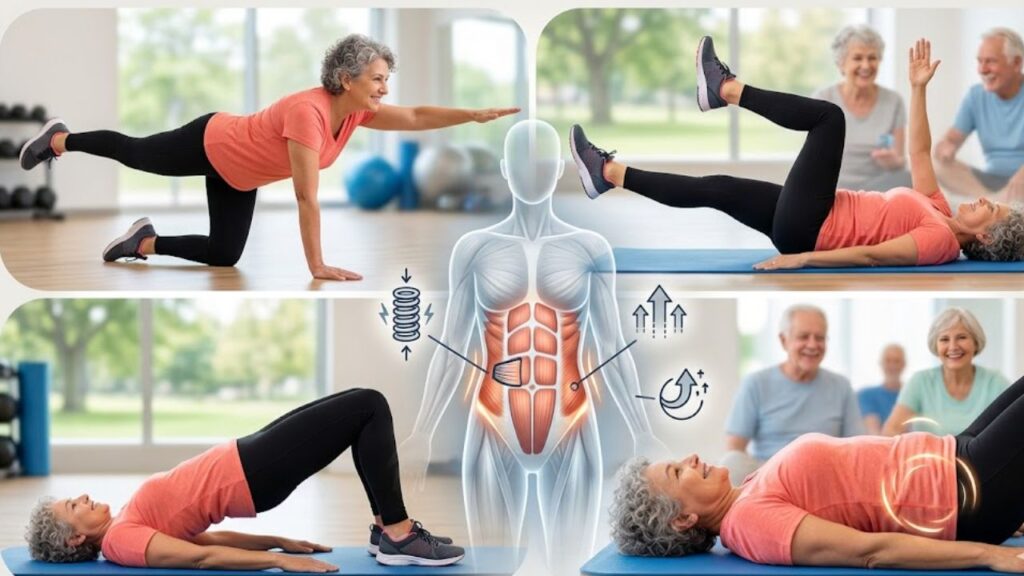
Bird Dogs
Bird dogs help you improve your spinal stability and cross body coordination. Once you can do this move perfectly, you’ll be able to do a perfect plank.
Muscles worked: glutes lower back, transverse abdominis, and shoulders
How to Do It:
- Get down on your hands and knees and start there.
- Slowly move your right leg back horizontally.
- Also, stretch your left arm straight out in front of you.
- For up to 30 seconds hold
- Change sides and do it again.
Sets and reps that are suggested three rounds of up to 30 seconds on each side as part of the full circuit
 If You Can Master These 4 Bed Exercises at 60, Your Core Is Stronger Than Most 50-Year-Olds
Tip for form: Don’t let your hips move or your lower back arch. Keep your spine straight and move slowly and on purpose.
Hollow Hold
This is a very hard core exercise, and I mean that as a compliment. It works the deep core muscles in the same way that a plank does by making them tighter without moving them. The entire front chain of the body needs to work. One of the most important parts of a good plank is not letting the lower back move. The hollow hold trains the lower abs to do just that. I still can’t do this move without my abs shaking.
Muscles worked: deep core transverse abdominis, lower abs, hip flexors, and shoulders
How to Do It:
- Lay down on your back on the mat
- Push your lower back hard into the mat.
- Raise your head and feet a few inches off the floor.
- Bring your fingertips to your feet.
- Hold for as long as 30 seconds.
Suggested Sets and Reps: As part of the full circuit, you can do this for up to 30 seconds, three times.
Tip: Don’t let your lower back lift off the mat; that’s the whole point of the move. Keep pushing it down the whole time.
How to Put This Circuit in Your Weekly Workout Plan
If you’re just starting to get in shape, I suggest doing this core circuit at the end of your workout routine once or twice a week. Do all three moves in a row, then do the circuit three times in a row.
Always pay attention to what your body is telling you, and your doctor will tell you what exercise program is best for you.
What to Expect in 4–6 Weeks
The word realistic is the key here. I always have to tell my clients that they can’t just do sit ups and planks to get six pack abs. Nutrition and lifestyle are very important when it comes to how you look.
That being said, here’s what you can realistically expect after doing these moves for four to six weeks:

- Shoulders and chest muscles that are stronger and more stable
- Hip flexors that are stronger
- Better balance
- Better core strength and stability that helps with other exercises and everyday tasks
- A smaller waistline, if you eat right
If one of your goals is to hold a plank, you’re making real progress it’s worth the risk. These moves do a lot of work without making a sound, and so will you.