
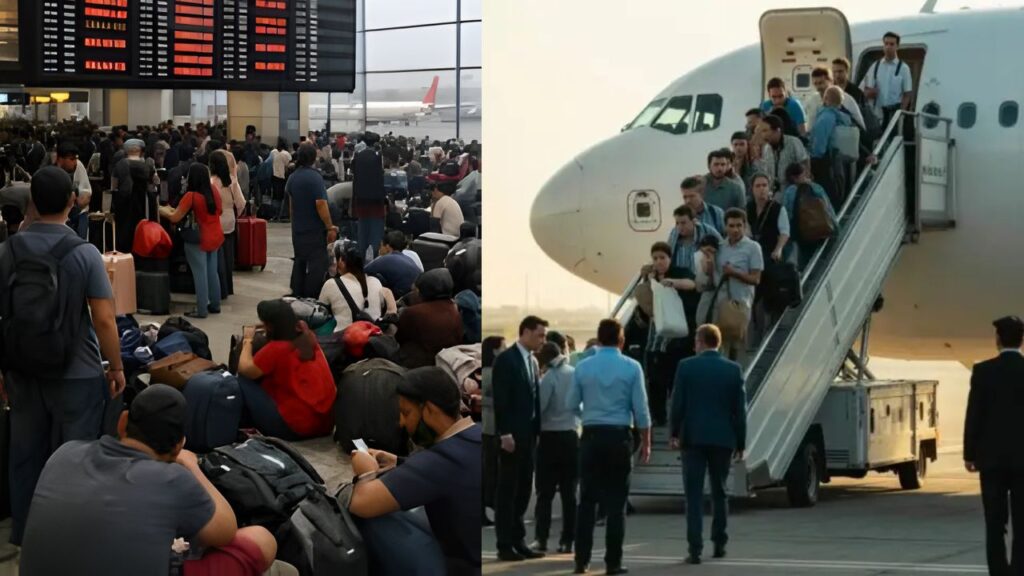
Thousands of travelers are stuck in major Gulf transit hubs due to the ongoing travel disruptions in the Middle East, which are brought on by escalating geopolitical tensions and unstable airspace conditions. As a result, airlines and governments from all over the world—including the US, UK, Canada, Spain, Germany, the Netherlands, Thailand, India, and more—have united to provide vital aid and repatriation flights to those stranded in the area, resulting in an incredible demonstration of international cooperation worldwide. Here is an update on the efforts being made by nations to assist stranded travelers in returning home and to reestablish international air connectivity.
Geopolitical tensions and airspace disruptions are the root cause of the crisis.
The crisis started when rising regional tensions compelled several Middle Eastern nations, including Saudi Arabia, the United Arab Emirates, and Oman, to modify their airspace regulations and impose flight restriction policies. As the geopolitical situation became more unstable and severely disrupted international flight routes, these safety precautions were implemented. Travelers who had been en route to locations all over the world consequently found themselves stranded in airports and transit hubs throughout the region, unable to proceed with their travels.
Airports such as those in Dubai, Abu Dhabi, and Muscat became overcrowded holding points with tens of thousands of stranded travelers waiting for delayed or cancelled flights. It was obvious that quick action was required to enable travelers to return home safely and effectively and to guarantee that international aviation networks could start to stabilize.

The Global Reaction: Emergency Assistance and Repatriation Flights
Governments and airlines have collaborated to initiate a coordinated effort to offer crucial assistance to stranded passengers in the face of the crisis. Among the major airlines that started repatriation flight operations were Qatar Airways, Emirates, Etihad Airways, and IndiGo. These flights moved thousands of passengers out of the affected areas and restored connectivity between the Middle East and major global destinations.
For instance, Qatar Airways successfully operated a number of long-haul flights on March 8, 2026, including arrivals from London, Paris, Madrid, Rome, Frankfurt, and Bangkok. These flights landed at Doha’s Hamad International Airport, underscoring Qatar’s continued importance as a hub for the Gulf region’s connections between Europe and Asia. Qatar Airways maintained its worldwide network and assured passengers that their connections were still functional in spite of the unpredictability in regional airspace.
Support for Travelers Who Are Stranded and Repatriation Flights
Emirates Airlines has continued to run a wide range of international flights out of Dubai International Airport alongside Qatar Airways. One of the most significant aviation hubs in the world, Emirates, made sure that vital flights for important cities in North America Europe, Africa, and Asia took off. These flights, which traveled from New York and Dallas to London, Paris, Frankfurt, and other places, were crucial in assisting stranded travelers in returning home.
With routes connecting important cities like Mumbai, Hyderabad, and Abu Dhabi, Abu Dhabi-based Etihad Airways maintained connectivity between the Gulf region and India. For business and tourism, as well as for Indian expatriates residing and working in Gulf nations, this connectivity is essential. Similar to this, IndiGo Airlines increased the number of flights it operated internationally, linking cities like Delhi, Bengaluru, Mumbai, and Hyderabad with locations in the Middle East and Europe.
Humanitarian Actions: Accommodations, Extensions of Visas, and Transportation Support
Several nations, including Sri Lanka, Turkey, Qatar, Bahrain, and Oman, implemented a variety of emergency measures to offer food shelter and legal assistance to stranded travelers as part of a coordinated effort to support them. For instance, Sri Lanka and Oman offered visa extension support to guarantee that foreign visitors would not encounter legal issues while waiting for their rescheduled flight departures, while the United Arab Emirates offered free hotel accommodations.

In order to guarantee seamless and effective transfer procedures and avoid additional delays for travelers attempting to reach their final travel destinations, nations like Turkey and Qatar also collaborated with transit hubs and airport authorities. Governments and airlines collaborated to lessen the impact on passengers, demonstrating a coordinated caring response to a global emergency situation.
Restoring Worldwide Air Connectivity: A Coordinated Effort
In addition to clearing airport backlog congestion, this outstanding international cooperation has shown how resilient the global aviation network is in emergency situations. The cooperation between airlines governments and aviation authorities has demonstrated that, in the event of an emergency, the global aviation infrastructure can quickly adapt and respond, despite the difficulties presented by geopolitical instability.
The geopolitical ramifications of such a crisis are substantial, according to defense policy experts in Brussels, since nations that control airspace and transportation corridors have a great deal of influence over the movement of international travelers worldwide. However, the successful repatriation flight operations and the quick mobilization of resources demonstrate that nations can band together to safeguard travelers’ interests and maintain the operation of vital air routes even in the face of uncertainty.
The Path Ahead: Maintaining Air Travel Stability
The coordinated response to the crisis emphasizes the significance of adaptability and resilience in international travel networks, even though the Middle East situation is still unstable. International flights are anticipated to gradually return to normal as airspace stability improves and diplomatic solutions are sought.
Meanwhile, a number of special repatriation flights are being used to transport passengers who are stranded in the area back to their home countries safely as part of ongoing repatriation assistance efforts. In order to ensure that stranded travelers have access to the assistance they require to safely return home, this international solidarity will probably serve as a model for future responses to similar crises.
Conclusion: An Effective Illustration of International Collaboration
The 2026 Middle East travel crisis has highlighted how susceptible global travel networks are to geopolitical development impacts. But it has also brought attention to the strength of global solidarity and collaboration. Countries all over the world have demonstrated that, in spite of the difficulties, they can react to crises with compassion and workable solutions through repatriation flights emergency accommodations, and diplomatic cooperation. In addition to ensuring the security and welfare of thousands of stranded travelers, this crisis response reaffirmed the importance of a global response to travel disruption challenges.
 Collagen Supplement Guide Explains How They Support Skin Hair Nails and Overall Beauty Health